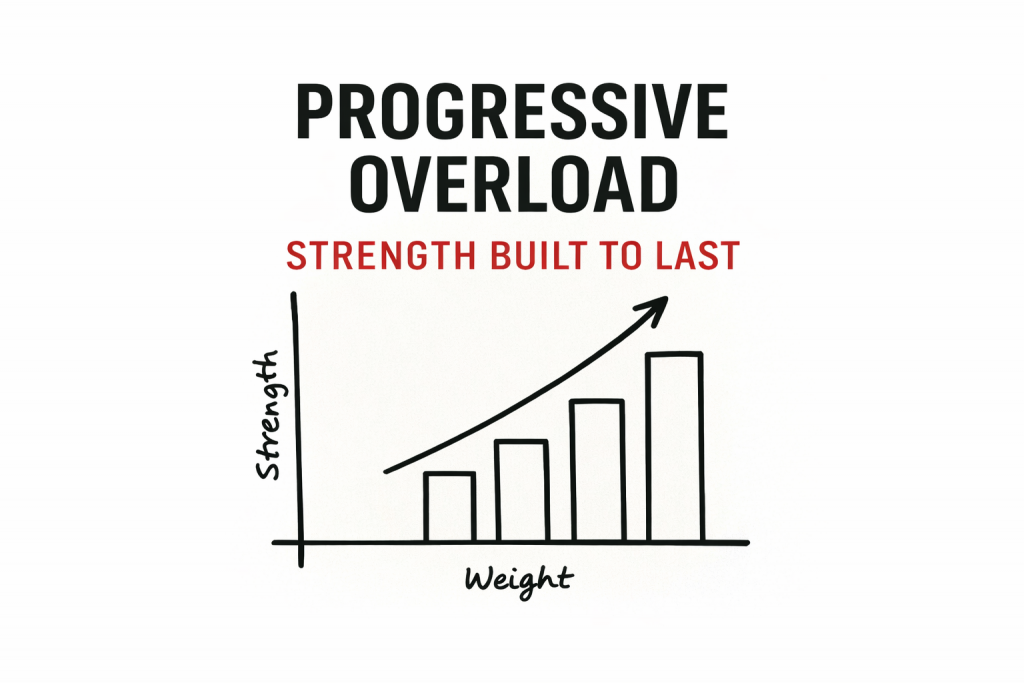
Progressive overload isn’t about lifting heavier every week until something snaps.
It’s about applying enough stress to force adaptation, then repeating that process consistently over time.
Most people treat it like a race. The Constancy Code treats it as a system.
What Is Progressive Overload?
Progressive overload means systematically increasing training demand so your body continues to adapt.
That demand can increase through:
- More weight
- More reps
- More sets
- Reduced rest intervals
- Slower tempo
- Improved technique
Progression isn’t always heavier loads. Sometimes the adaptation comes from executing the same weight with better control and cleaner mechanics.
Why Most People Get It Wrong
They escalate too quickly. They attempt personal records weekly. They follow influencers who equate progress with suffering.
That’s not progressive overload. That’s ego lifting and accumulated fatigue masquerading as discipline.
True progression respects recovery capacity and joint integrity. It builds durability alongside strength.
The Polarization Principle
The concept underlying structured progression has roots in Soviet training methodology. In the book Tactical Barbell by K Black, this approach is termed “polarization” — the practice of alternating between different training intensities and volumes to drive adaptation while managing fatigue.
Stephen Seiler’s research on polarized training models demonstrates that athletes who spend approximately 80% of training time at low-to-moderate intensity and 20% at high intensity achieve better long-term performance outcomes than those who constantly train at moderate-high intensity. This framework prevents the chronic fatigue that derails most training programmes.
The principle: stress and recovery must be managed as a system, not just variables to maximize weekly.
How to Apply It in Practice
1. Track performance weekly
Record weight, reps, and subjective effort (RPE). Without data, progression is guesswork.
2. Use structured logging
Training sheets like those in the Starter Pack provide clarity and prevent drift.
3. Commit to 4-week minimum blocks
Adaptation requires repetition. Changing exercises or schemes every week undermines progress.
4. Increase training volume strategically
Volume = Sets × Weight × Reps. Progression comes from increasing this product over time, not just adding weight.
5. Respect the adaptation curve
Progress occurs in cycles. Forcing linear gains every week leads to stalls, injury, or regression.
What About Injury Risk?
Progressive overload does not mean sacrificing joint health for numbers.
If form deteriorates or pain increases, you’re moving backwards — not forwards. Progressive training, done correctly, allows muscles, tendons, and connective tissue to adapt together.
Research on tendon adaptation shows that collagen synthesis peaks 24–72 hours post-training and requires months of consistent loading to increase structural integrity. Rushing this process invites tendinopathy and chronic pain.
Progression protects when it’s systematic. It damages when it’s reckless.
Signs It’s Working
- Lifts feel smoother at the same weight
- Rest intervals between sets decrease naturally
- Recovery between sessions improves
- Mental demand of training reduces
If you’re still overthinking every set after three weeks, the programme is too complex. Simplify.
Bottom Line
Progressive overload isn’t a shortcut. It’s the fundamental mechanism of adaptation.
It rewards patience and structure. It punishes ego and inconsistency.
If you want strength that lasts, track your work and keep the system simple.
Download the Starter Pack for your 4-week training logbook and sample plan.
References
Seiler, S. (2010). What is best practice for training intensity and duration distribution in endurance athletes? International Journal of Sports Physiology and Performance, 5(3), 276-291.
Miller, B. F., Olesen, J. L., Hansen, M., Døssing, S., Crameri, R. M., Welling, R. J., … & Kjaer, M. (2005). Coordinated collagen and muscle protein synthesis in human patella tendon and quadriceps muscle after exercise. The Journal of Physiology, 567(3), 1021-1033.
Kyrolainen, H., Hackney, A. C., Salminen, R., Repola, J., Häkkinen, K., & Haverinen, M. (2018). Effects of combined strength and endurance training on physical performance and biomarkers of healthy young women. Journal of Strength and Conditioning Research, 32(6), 1554-1561.